


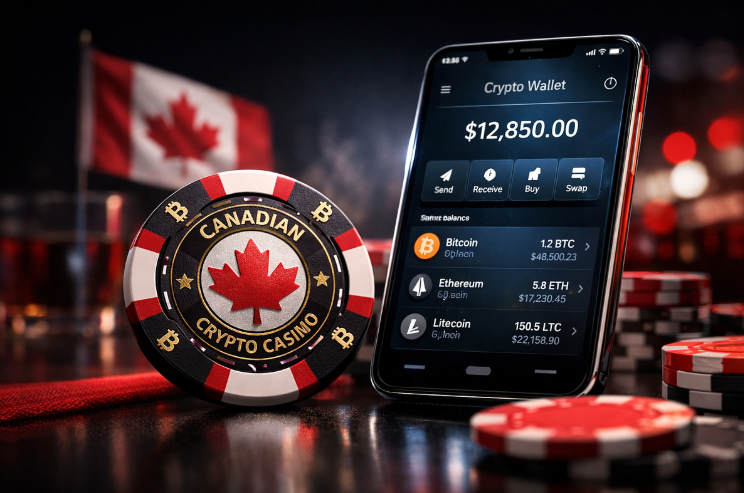
Cryptocurrency has moved well beyond trading and long-term investing. Bitcoin, stablecoins and blockchain payments are increasingly being used to move value between digital platforms, including online casinos serving Canadian players.
For someone who already understands crypto, the appeal is easy to see. A wallet can transfer funds without relying on a traditional card transaction, multiple digital currencies may be supported, and blockchain settlement can remove some of the intermediaries associated with conventional payments.
Engedély nélküli tőzsdén tartod a kriptód?
Július 1. óta EGT-ben csak MiCA-engedéllyel lehet kiszolgálni az európai ügyfeleket. Az OKX megszerzett minden engedélyt – és aki most költözik át, akár 8% bónuszt kap az új befizetésére!
[Váltok szabályozott tőzsdére →]
But GambleOnline.ca takes a more cautious view of the category: accepting Bitcoin does not automatically make an online casino safer, faster or better.
A useful Canadian crypto casino comparison still needs to examine who operates the platform, what happens before a withdrawal is approved, which blockchain networks are supported, how bonuses work, whether identity verification may be required and what happens when crypto is converted into Canadian dollars.
That distinction is especially important for crypto users. Blockchain technology can make the transfer itself transparent while leaving many parts of the casino experience dependent on the operator.
What Is a Canadian Crypto Casino?
A Canadian crypto casino is generally an online casino available to eligible Canadian players that accepts one or more cryptocurrencies for deposits, withdrawals or both.
Bitcoin remains the most recognizable option, but modern crypto-friendly casinos can also support Ethereum, Litecoin, Bitcoin Cash, Dogecoin, Tron, USDT, USDC and other assets.
The exact implementation varies.
At one casino, a player might deposit Bitcoin and maintain the account balance in BTC. At another, the casino may convert the cryptocurrency into Canadian dollars or another fiat currency once the deposit arrives.
That difference matters because it determines whether the player’s casino balance remains exposed to crypto-market volatility.
Crypto support should therefore be understood as part of the casino’s payment infrastructure rather than a description of the entire platform.
Bitcoin Casinos, Stablecoin Casinos and Multi-Crypto Platforms
Not every crypto casino works in the same way.
| Type | Typical Setup | Most Relevant For |
| Bitcoin casino | Primarily supports BTC | Existing Bitcoin holders |
| Multi-crypto casino | BTC, ETH, LTC and other assets | Players wanting several payment choices |
| Stablecoin casino | Supports USDT, USDC or similar assets | Players wanting less price volatility |
| Hybrid casino | Crypto plus cards, e-wallets or other banking | Players wanting maximum payment flexibility |
Bitcoin still has the strongest brand recognition, but stablecoins deserve particular attention.
Assets such as USDT and USDC are designed to track the value of the U.S. dollar. For someone using cryptocurrency primarily as a payment rail rather than as a speculative asset, that can be useful because the value of the transaction is generally more predictable than when using BTC or ETH.
Kripto Akadémia has previously examined how stablecoin payments are developing into a broader internet settlement layer, highlighting the appeal of faster, cross-border digital settlement. Online gambling is one example of the wider class of platforms experimenting with these payment rails.
Stablecoins still introduce another technical consideration: the network.
USDT, for example, can operate on multiple blockchains. A user needs to make sure the network selected in the wallet matches the network accepted by the casino.
How GambleOnline.ca Evaluates Canadian Crypto Casinos
GambleOnline.ca does not rank a casino highly simply because cryptocurrency appears in its cashier.
Its review framework looks at operator transparency, regulatory information, Canadian banking, bonus terms, game selection, usability, customer support, player feedback and responsible gambling controls.
That approach matters because crypto acceptance answers only one question: Can I transfer a particular digital asset to this platform?
It does not answer whether withdrawals are straightforward, whether terms are clearly disclosed, whether the game library is suitable or whether the casino’s ownership information is easy to identify.
Canadian readers researching individual operators can use GambleOnline.ca’s online casino reviews to compare banking, bonuses, withdrawals, games and other practical details before opening an account.
The site’s review database also illustrates how widespread crypto support has become. Operators covered by GambleOnline.ca list payment methods including Ethereum, Litecoin, Bitcoin Cash, Dogecoin, USDC, Tron and other digital currencies alongside conventional payment methods.
How a Crypto Casino Deposit Works
The basic transaction should be familiar to anyone who has transferred cryptocurrency between wallets.
Imagine a Canadian player wants to deposit approximately C$100 worth of Bitcoin.
The player first opens the casino cashier and selects BTC as the deposit method.
The casino generates a receiving address, usually displayed as both a string of characters and a QR code.
The player opens their own wallet, enters the casino’s address, chooses the amount and confirms the transaction.
The Bitcoin network then processes the transfer. The casino credits the account after receiving the number of confirmations required by its payment system.
The process sounds simple, but there is one important difference from many conventional payments: crypto transfers generally do not have a straightforward chargeback or cancellation mechanism.
Before pressing send, check the asset, network, address and amount.
Speed is useful. Accuracy is more important.
The Network Matters as Much as the Coin
One of the easiest mistakes for a new crypto user is to focus on the token while ignoring the blockchain network.
Consider USDT.
A casino may accept USDT on one network but not another. Sending the correct token through an unsupported network can create serious problems recovering the funds.
Ethereum-based assets can also involve gas fees, while other networks have their own fee and confirmation structures.
This means a cashier displaying “USDT accepted” is not enough information.
The player should confirm exactly which network is supported before initiating the transfer.
The same principle applies to deposit addresses. Copying and pasting an address is safer than manually typing one, but the user should still verify the first and last characters before authorizing the transaction.
How Crypto Casino Withdrawals Work
Withdrawals reverse the payment flow.
The player enters a wallet address capable of receiving the selected cryptocurrency and submits a withdrawal request.
At this point, two completely different processes begin.
The first is controlled by the casino.
The operator may review the withdrawal, check bonus conditions, apply withdrawal limits or request identity verification.
Only after approval does the blockchain become relevant.
The casino then broadcasts the crypto transaction, the network processes it and the player’s wallet recognizes the incoming funds after the necessary confirmations.
This distinction is essential when evaluating claims about fast crypto withdrawals.
A blockchain may settle quickly while a casino takes considerably longer to approve the payout.
GambleOnline.ca separates casino approval time from payment-provider delivery time when evaluating payment performance for precisely this reason.
Are Crypto Casino Withdrawals Really Faster?
They can be, but “crypto equals instant withdrawals” is too simplistic.
Consider two hypothetical casinos.
Casino A uses a fast blockchain but keeps withdrawal requests pending for 24 hours before reviewing them.
Casino B approves requests rapidly but uses a network that requires more time for confirmations.
The total experience might be faster at Casino B despite the network itself being slower.
Other variables include Know Your Customer checks, account limits, bonus verification, network congestion and the particular asset being withdrawn.
For this reason, anyone comparing crypto casinos should ask two separate questions:
How long does the casino take to approve the withdrawal?
How long does the blockchain transfer take after approval?
Combining both stages into one vague “fast payout” claim can hide where delays actually occur.
Stablecoins May Make More Sense Than Bitcoin for Payments
Bitcoin can be convenient for people who already hold it, but its price volatility introduces another variable into casino banking.
Suppose a player sends C$500 worth of BTC.
If the casino keeps the account balance denominated in Bitcoin, the Canadian-dollar value of that balance can rise or fall independently of any gambling result.
Stablecoins reduce that particular problem because their purpose is to maintain a relatively stable relationship with a reference currency, usually the U.S. dollar.
For players thinking primarily about payments rather than Bitcoin price exposure, USDT or USDC may therefore offer a simpler accounting experience.
That doesn’t remove every risk.
Stablecoins depend on their issuers, reserves, technical infrastructure and supported networks. They should not be treated as identical to holding Canadian dollars in a bank account.
The point is narrower: stable-value assets can make casino deposits and withdrawals easier to budget than highly volatile cryptocurrencies.
Crypto Casino Fees Canadians Should Understand
Crypto payments can eliminate some conventional banking costs, but they are not automatically free.
Several fees can appear during the complete transaction.
First, the blockchain may require a network fee.
Second, an exchange may charge for purchasing or selling the cryptocurrency.
Third, converting CAD into crypto or back into CAD can involve a spread or currency-conversion cost.
Finally, the casino itself may have withdrawal minimums, payment fees or conversion rules.
This means a casino advertising “zero withdrawal fee” does not necessarily make the full process cost-free.
Imagine buying Bitcoin with Canadian dollars, transferring it to the casino, withdrawing BTC later and then selling it back into CAD.
The total transaction cost includes every stage, not merely what the casino charges.
Crypto users accustomed to comparing exchange fees should apply the same discipline to gambling platforms.
What Happens When a Casino Converts Crypto Into CAD?
The account currency can materially change the experience.
Suppose a player sends approximately C$100 worth of Bitcoin.
Casino A converts it into CAD once the transaction is credited.
Casino B leaves the balance denominated in BTC.
At Casino A, subsequent Bitcoin price changes no longer affect the displayed C$ balance in the same way.
At Casino B, the Canadian-dollar value of the balance continues to fluctuate with BTC.
Neither setup is inherently better.
A Bitcoin holder may prefer keeping the balance denominated in crypto. A Canadian player budgeting in dollars may prefer immediate conversion into CAD.
What matters is understanding how the platform handles the conversion before depositing.
Crypto Bonuses Require the Same Scrutiny as Any Other Promotion
Crypto-specific welcome offers can advertise large percentages because operators want to encourage digital-asset deposits.
The percentage alone says very little.
Suppose Casino A advertises a 200% Bitcoin bonus with 40x wagering.
Casino B advertises a 100% crypto bonus with 20x wagering.
The first promotion looks twice as large.
But the second may require substantially less qualifying play.
Players should also check what the wagering multiplier applies to. A requirement based only on bonus funds can produce a very different wagering total from the same multiplier applied to the deposit plus bonus.
Other conditions can include minimum deposits, eligible games, maximum bonus bets, expiry periods and cashout limits.
Crypto should not distract players from ordinary casino mathematics.
The blockchain may be new technology. Wagering requirements are still wagering requirements.
Do Crypto Casinos Require ID Verification?
Using Bitcoin does not necessarily mean gambling anonymously.
Crypto payments and casino account verification are separate issues.
A casino can accept BTC while still requesting proof of age, identity, address or payment ownership.
Verification may occur during registration, after certain account activity or when a withdrawal is requested.
The exact conditions differ between operators.
GambleOnline.ca specifically examines identity-verification requirements when reviewing Canadian casino banking because unexpected KYC checks can materially affect withdrawal experiences.
Players who choose crypto because they assume it guarantees anonymity may therefore misunderstand how the casino relationship works.
What Does “Provably Fair” Actually Mean?
Provably fair gaming is closely associated with crypto casinos.
The concept uses cryptographic methods that can allow a player to verify that a game outcome was generated according to the stated algorithm and was not altered after the bet was placed.
That can provide useful transparency at the game level.
But it is important not to extend the claim beyond what the technology proves.
Provably fair does not automatically establish that an operator will process withdrawals properly.
It does not prove that bonus terms are fair.
It does not establish regulatory compliance.
It does not guarantee that a player will win.
A casino can use technically verifiable games while still performing poorly in unrelated areas.
Crypto users should think of provably fair systems much like on-chain verification elsewhere in the industry: they can verify a specific piece of information, but they do not eliminate the need to evaluate the platform around it.
Crypto Casino Games Are Still Casino Games
The payment rail doesn’t change the underlying mathematics of most casino games.
A slot funded with Bitcoin still has an RTP and volatility profile.
Blackjack still depends on rules, strategy and house edge.
Roulette still has a mathematical advantage built into the wheel.
Live dealer games still depend on table limits, providers and game rules.
For this reason, GambleOnline.ca evaluates game selection separately from banking.
A casino can provide excellent crypto payment options and still have a poor game library.
Before depositing, check whether the site actually carries the games and software providers you want.
Pay particular attention to RTP information on slots because some developers provide multiple RTP configurations of the same title.
Crypto Casinos vs. Interac for Canadian Players
Cryptocurrency isn’t the only digital payment option available to Canadians.
Interac remains familiar to many players because it connects directly with Canadian banking.
| Factor | Crypto | Interac |
| Primary currency | Digital assets | CAD |
| Separate wallet needed | Usually | No |
| Price volatility | Possible | No |
| Network fee | Possible | No blockchain fee |
| Blockchain knowledge | Helpful | Not required |
| Conversion between CAD and crypto | May be required | Usually unnecessary |
| Payment availability | Operator dependent | Operator dependent |
For someone already active in crypto, wallet-based payments may feel straightforward.
For someone who receives income, budgets and banks entirely in CAD, buying cryptocurrency solely to make a casino deposit may add unnecessary complexity.
The most sophisticated payment method isn’t automatically the best one.
Common Mistakes at Canadian Crypto Casinos
Sending funds over the wrong network is among the most serious avoidable errors.
Another is assuming a transaction can easily be reversed after using an incorrect wallet address.
Players can also underestimate network and conversion fees because the casino itself advertises free deposits.
Another frequent mistake is assuming that a large crypto bonus automatically offers more value than a smaller conventional promotion.
And perhaps the biggest conceptual mistake is treating crypto as a substitute for researching the operator.
Bitcoin support, provably fair technology, licensing information and withdrawal reliability describe different parts of the experience.
One cannot substitute for another.
Provincial Differences Still Apply
Canada should not be treated as one completely uniform online gambling market.
Operator availability and regulatory frameworks can vary by province.
Ontario operates its own competitive regulated iGaming model, while other provinces use different structures.
A casino accepting Canadian dollars and Bitcoin does not automatically mean it is available under identical conditions everywhere in Canada.
Players should therefore verify eligibility based on their physical location and the rules applicable to their province before registering.
This provincial context is one reason GambleOnline.ca evaluates gambling platforms specifically from a Canadian perspective rather than treating Canada as simply another international market.
Who Should Consider Using a Crypto Casino?
Crypto casino payments make the most sense for people who already understand cryptocurrency.
Someone who owns Bitcoin or stablecoins, knows how wallets work, understands networks and can evaluate transaction fees is likely to find the process relatively familiar.
The calculation is different for a complete beginner.
Buying cryptocurrency for the first time solely to claim a casino bonus means learning two unfamiliar systems at once: crypto payments and online gambling terms.
That creates more opportunities for errors.
A player should understand the payment method before using it.
There is no advantage in making a casino deposit technologically more complicated than necessary.
How to Evaluate a Canadian Crypto Casino Before Depositing
Start with the operator rather than the cryptocurrency.
Identify who runs the casino and what licensing or regulatory information it publishes.
Then examine the cashier.
Confirm the exact cryptocurrencies supported, accepted networks, minimum deposits, withdrawal limits and any fees.
Read the withdrawal rules before depositing, not after winning.
Check whether identity verification can be required.
If taking a bonus, calculate the wagering requirement and identify eligible games, maximum bets, expiry periods and withdrawal restrictions.
Then inspect the game library and providers.
Finally, locate customer support and responsible gambling controls.
If any important condition is difficult to understand, obtain clarification before sending cryptocurrency.
That process is less exciting than selecting a coin and scanning a QR code.
It is also far more useful.
Are Canadian Crypto Casinos Safe?
Crypto acceptance alone cannot establish whether an online casino is safe.
Players should independently evaluate ownership information, licensing, terms, withdrawal procedures, security, software providers, customer support and reputation.
Crypto-specific checks should then be added, including supported networks, wallet requirements and transaction conditions.
Can Canadians Use Bitcoin at Online Casinos?
Some online casinos serving Canadian players accept Bitcoin for deposits and withdrawals.
Availability, transaction minimums, networks, confirmations and withdrawal rules vary by operator.
Can Canadians Use USDT at Online Casinos?
Some crypto-friendly casinos support USDT.
The most important practical step is checking which blockchain network the casino accepts before transferring funds.
USDT on one network should not automatically be assumed compatible with a deposit address intended for another.
Is USDT Better Than Bitcoin for Casino Payments?
It depends on the user’s objective.
Bitcoin may make sense for someone who already holds BTC.
USDT may be more practical for someone who wants crypto payment infrastructure without the same degree of short-term price volatility.
Neither automatically makes the casino itself better.
Are Crypto Casino Withdrawals Faster Than Bank Withdrawals?
They can be, but the casino’s internal approval process can be more important than the blockchain’s speed.
Players should separately compare casino approval times and network settlement times.
Do Crypto Casinos Require KYC?
Some do.
Accepting cryptocurrency does not prevent an operator from requiring identity, age or address verification.
Review the casino’s verification terms before depositing.
Do Crypto Casino Transactions Have Fees?
They can.
Potential costs include blockchain network fees, exchange charges, conversion spreads and casino-level fees or transaction conditions.
Evaluate the complete payment journey rather than the casino fee alone.
Can a Bitcoin Casino Transfer Be Reversed?
Blockchain transactions generally do not provide the same straightforward reversal mechanism as some conventional payments.
Always verify the wallet address, network and amount before confirming a transfer.
Is a Provably Fair Casino Automatically Trustworthy?
No.
Provably fair technology can help verify game outcomes, but it does not independently verify operator reliability, withdrawal practices, bonus fairness, licensing or customer service.
Those areas still need to be researched separately.
The Bottom Line for Canadian Crypto Casino Users
Crypto casinos illustrate one of blockchain’s most practical use cases: transferring value directly between a user wallet and an online platform.
For experienced crypto users, Bitcoin and stablecoins can provide another convenient payment option. Stablecoins may simplify budgeting, while different blockchain networks can offer different settlement characteristics and costs.
But payment technology should not overshadow operator risk.
The strongest Canadian crypto casino isn’t necessarily the platform accepting the most coins or advertising the largest Bitcoin bonus. It is one where the payment process, withdrawal conditions, ownership information, games and terms can all be understood before money is sent.
That is the approach GambleOnline.ca applies to casino comparisons: start with verifiable information, understand the conditions and treat cryptocurrency as one component of the broader player experience.
About GambleOnline.ca

GambleOnline.ca is an independent online gambling media website founded in 2008, publishing experience-based reviews, guides and analysis of online casinos, sportsbooks and poker platforms. Its editorial team conducts hands-on testing and research to provide factual, player-focused insights, alongside educational content on gambling strategy, legality and responsible play.